
Washington County Supervision Types
Washington County Community Corrections works with three statuses that sound alike but arise in different ways. Probation is generally a community sentence imposed by a court. Parole is a conditional release used for Oregon populations who remain legally eligible for discretionary parole. Post-prison supervision, often shortened to PPS, follows many determinate state prison terms. In each case, a person can live outside a secure prison while still being subject to conditions and an assigned officer.
The Oregon Board of Parole and Post-Prison Supervision, or BOPPPS, sets conditions for people leaving Oregon prisons on parole or PPS. Washington County Community Corrections performs the field supervision for people assigned locally. The Circuit Court judgment is the best starting record for probation. An Oregon Department of Corrections record or Board order may explain a prison-to-supervision transition, but neither should be confused with the final discharge from the sentence.
| Status | How it begins | Primary confirming record | Local role |
|---|---|---|---|
| Probation | Imposed by a court as a community sentence | Circuit Court judgment and later orders | Washington County Community Corrections supervises an assigned case |
| Parole | Conditional release for a parole-eligible sentence | Board Action Form or Board order | Local officers carry out field supervision |
| Post-prison supervision | Follows many determinate Oregon prison terms | Judgment, ODOC record, and supervision record | Local officers supervise under state-set conditions |
Note: Release from physical custody and discharge from legal supervision are separate events and may occur on different dates.
Verify Washington County Post-Release Supervision
No verified public Washington County name-by-name probation roster exists. Verification therefore depends on matching the person across the official channel tied to the sentence. Use a full name, SID number, court case number, and birth details when lawfully available. A name alone is not enough. The Washington County released-inmate search paths can first establish which custody system handled the release.
- Identify the sentence source. Use the Washington County Circuit Court judgment for probation, or Oregon Offender Search for a person sentenced to ODOC.
- Read each label exactly. A projected date, custody status, parole order, and supervision discharge describe different events.
- Check the Board record when parole is involved. A hearing calendar only shows that a hearing was scheduled. Request the Board Action Form or final order for the outcome.
- Contact the local office. Give Washington County Community Corrections adequate identity and case details when asking whether that office is responsible for supervision.
- Check live custody and court records for a claimed violation. A warrant, arrest, or Board action must be confirmed in its own official source.
- Request the discharge record. When the end of supervision matters, ask for the document that states discharge rather than treating elapsed time as proof.
Washington County Supervision Office
The official local contact is Washington County Community Corrections Probation and Parole. Its staff supervise probation, parole, and PPS cases assigned to Washington County. They may confirm the proper office when a requester supplies enough detail, but safety, treatment, victim, and other protected information may not be public. Officer assignments can also change after a person’s first release-day meeting.
The county’s published office information is shown below. A court case number or Oregon SID helps staff distinguish people with the same name. For the judgment itself, use Washington County Circuit Court. For a state prison release record, use ODOC. For a Board decision, use the BOPPPS records channel.
Community Corrections Probation and Parole
Mail stop: MSC 46
Address: 150 N First Avenue, Suite 200
Hillsboro, OR 97124
Phone: 503-846-3400
The manifest image comes from the county’s official Probation and Parole page.
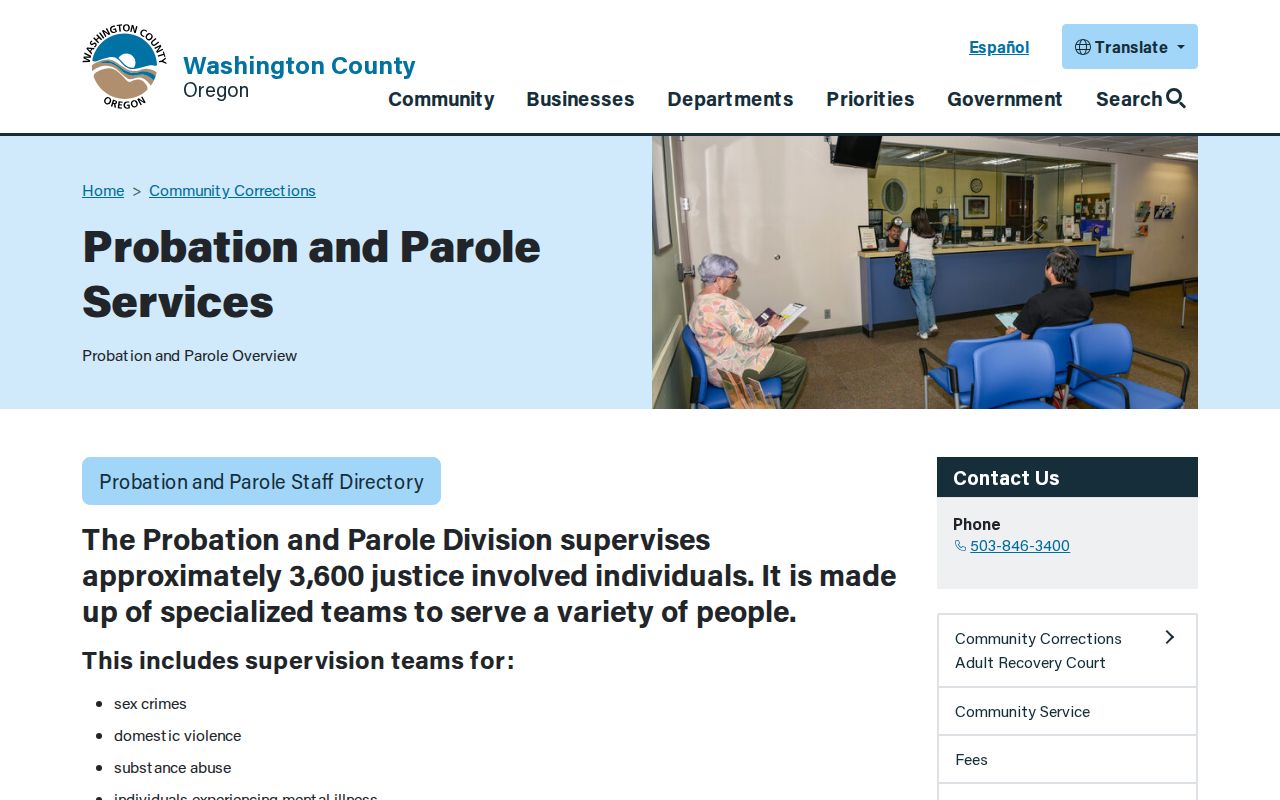
It identifies the local government channel used to route supervision questions, rather than offering a public list of supervised people.
Note: The public office can route a supported inquiry, but it is not a historical list of every person once supervised.
Washington County Release Settings
Two adjacent Washington County corrections settings have distinct roles. The Community Corrections overview reports supervision of about 3,600 adults in the community. The department also operates the Washington County Community Corrections Center, a 215-bed minimum-security residential facility near the jail. WCCCC prepares residents for a structured transition, but residence there is custody, not the same thing as ordinary community supervision.
The county’s Corrections Center FAQ does not publish anticipated WCCCC transfer timing. Bed space, court approval, and jail approval affect placement. That means a missing jail-roster entry cannot prove that a person went home, entered WCCCC, or began ordinary probation. The court order, jail transaction, Community Corrections record, and receiving placement must be read together. This distinction is especially important because the county jail and WCCCC are physically close while serving very different legal functions.
- Supervision
- Legal oversight in the community under stated conditions.
- Discharge
- The formal end of a sentence or supervision status.
- Detainer
- A request or legal basis for another authority to take custody.
- Absconder
- A status that must be established by the supervising authority, not inferred from missed contact.
Washington County Supervision Violations
Supervision conditions come from the judgment, Board order, and applicable agency rules. They can require reporting to an officer and compliance with case-specific directions. The full conditions should be read from the controlling record. A short public status label cannot show every term, and protected details may remain confidential.
An alleged violation does not equal a new conviction. BOPPPS describes violation hearings that determine whether a violation occurred and whether the response should include continued supervision, changed conditions, sanctions, or return to custody. A person described informally as an absconder may instead have a changed officer, a pending hearing, a warrant issue, or another status. Verify through the supervising agency, court warrant record, current jail search, and final Board action.
If a Board hearing appears on the official hearing calendar, treat it only as a scheduled event. Oregon does not provide a verified public name-search database of Board results. A named person’s outcome is recorded in a Board Action Form or order, available through the Board records-request channel. Codes on a form must be read in context. Even a code meaning that a release date was set refers to a future decision, not proof of physical release.
Note: Check the final order or judgment before describing an allegation, scheduled hearing, or warrant as a resolved supervision violation.
Washington County Release-Day Supervision
ODOC describes a prison release as a handoff. The person leaves the institution with directions to meet a parole or probation officer. The first officer assignment may later change. If an active detainer exists, the person may leave ODOC physical custody and enter the custody of the jurisdiction that lodged the detainer. The accurate statement is therefore that ODOC custody ended, followed by the destination shown in the receiving record.
Oregon VISOR can provide notices of release-date changes, transfers, and releases from participating sources, with ODOC describing updates at about two-hour intervals. VISOR is a notification tool, not a certified supervision roster. The Oregon Sex Offender Registry is also not a general list of released or supervised people. It covers only registrants whom state law makes publicly searchable, and a registry location does not prove the release date or the office supervising a sentence.
Property After Washington County Release
Washington County’s WCCCC departure rules create a practical deadline that is separate from supervision status. The center retains a former resident’s belongings for 30 days after departure. The former resident may retrieve the property with picture identification. After that period, unclaimed property may be donated or discarded.
If the past resident moved from WCCCC to Washington County Jail, the center requires that person to sign its release form before someone else can retrieve the property. This step can help a family plan, but it is not proof that the person entered the community or that parole, probation, or PPS ended. Use the court and supervision records for legal status. Use WCCCC only for the center’s resident and property process.
Note: The WCCCC property deadline begins after departure and should be handled separately from any question about discharge from supervision.
Washington County Supervision Discharge
Supervision ends through an official discharge, not merely because a projected term has passed. For probation, review the Circuit Court judgment and later orders. For parole or PPS, request the relevant ODOC or Board record. ODOC says a Pen Pack may contain first and last face sheets, judgments, and possibly parole-discharge, revocation, or structured-sanction material. A focused request should ask for the record that shows discharge from parole or post-prison supervision.
The distinction also protects accuracy. An OOS result may show that a person is no longer in an institution while supervision continues. A VISOR result may disappear after full discharge because the portal focuses on people in custody or under supervision. Neither a no-result nor a past projected date proves the legal end of the sentence. Record the source, retrieval date, displayed status, and date label, then obtain the final document when certainty is needed.