
Washington County Release Date Meanings
A projected release date is a calculation based on the judgments, sentence rules, and credits known to the responsible agency. It is prospective. The actual release date records a completed departure from physical custody. A parole-eligibility date marks when a person may qualify for a Board process, while a Board-set projected parole date reflects a decision in the smaller population governed by parole law. Supervision discharge is later still when community oversight continues after release.
Washington County records may span more than one custodian. The jail holds pretrial adults and people serving local sentences of less than 365 days. ODOC handles state prison sentences. Federal and immigration custody use separate systems. A transfer out of Washington County Jail ends that jail booking but does not establish a community release. Match the outgoing event with the next agency before describing where the person went.
Note: Record the retrieval date beside any projected date because later credits, orders, or holds may change the displayed calculation.
Find a Washington County Release Date
The correct route follows the sentence. Oregon Offender Search, or OOS, is the public state tool for an ODOC sentence. The Washington County jail roster is a present-tense custody tool, not a projected-date calculator. Court records explain the term and legal orders. The jail or ODOC then applies the calculation for the custody it controls.
- Confirm the custodian. Determine whether the person is in Washington County Jail, an ODOC institution, federal custody, or another agency’s custody.
- Read the judgment. Obtain the sentence, jail credit, concurrent or consecutive terms, and any amended judgment from the court case.
- Search OOS for an ODOC term. Accept the terms, use the SID when known, match identifiers, and copy the exact status, location, and projected-date label.
- Ask the jail about a county term. Provide the booking or JID and case details when requesting the jail’s actual calculation or completed release transaction.
- Check for a Board role. For a parole-eligible sentence, obtain the final Board Action Form or order instead of reading a hearing calendar as an outcome.
- Verify the event. Recheck the official system near the date and preserve the actual release record after it occurs.
The Washington County release search provides the broader records path when the person’s custody system is unclear. A negative jail result never proves release. It can also mean a delayed update, name mismatch, citation without lodging, transfer, or custody elsewhere.
ODOC Release Dates for Washington County
The Oregon Offender Search accepts a name or SID number. After opening the correct result, compare identifying details and transcribe each field exactly. Public detail may include the SID, status, location, sentence information, admission information, and an earliest or projected release-related date. OOS is built for people sentenced to ODOC, so it will not cover every person whose only custody was a county misdemeanor term or pretrial booking.
An administrative location also needs care. ODOC warns that Institution Based Records Office, or IBRO, is a records-office designation sometimes used while a person is temporarily in a county jail for a hearing. It is not proof of community release. A former ODOC record may show that physical state custody ended, but official or certified proof requires a Public Records Center request.
The manifest screenshot comes from the official ODOC offender-search guidance.
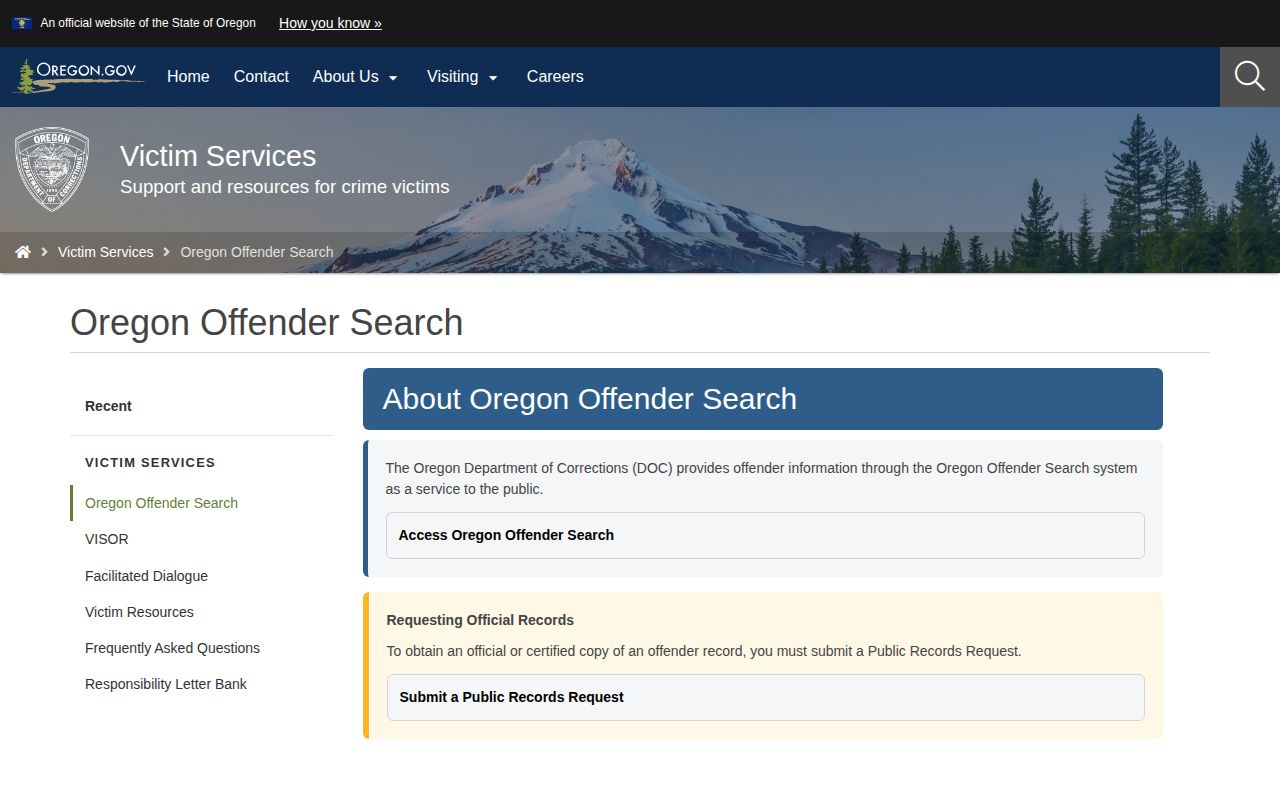
It identifies OOS as the public state lookup while directing official-record needs to ODOC records staff.
| Displayed item | How to read it |
|---|---|
| SID | Use it to distinguish people with similar names. |
| Status and location | Preserve the live label and do not turn an administrative location into a physical claim. |
| Projected or earliest release date | Treat it as the agency’s current calculation as of retrieval. |
| Sentence information | Compare it with the controlling judgment and amendments. |
Note: OOS is not a certified discharge record, and a state search will not resolve a county-only or federal sentence.
Washington County Earned-Time Rules
Oregon’s principal state earned-time law is ORS 421.121. For eligible felony terms after November 1, 1989, it authorizes credit tied to appropriate institutional conduct and participation in adult-basic-skills or case-plan work. The current law sets a maximum reduction of 20 percent of the total ODOC institutional term and prevents credits from reducing actual prison confinement below six months. Eligibility does not guarantee the maximum award.
The phrase “85 percent rule” is often used too broadly. ORS 137.635 can bar temporary leave, certain work release, and ordinary earned-time reduction when the court invokes that provision for a qualifying felony. ORS 137.700 establishes mandatory minimum prison terms for listed serious person offenses. Some covered sentences therefore require service of the mandatory term or do not receive ordinary earned-time reduction, but there is no sound rule that every Oregon prisoner serves one fixed percentage.
Other calculations may involve presentence custody credit under ORS 137.370, concurrent or consecutive terms, and Short-Term Transitional Leave under ORS 421.168 and applicable ODOC rules. The judgment, offense date, and governing version of law matter. Arithmetic based on one public date cannot replace the agency’s sentence computation.
Why Washington County Release Dates Change
ODOC’s recalculation materials state that sentence dates can change. The cause may be administrative, legal, or tied to custody conduct. A fresh OOS result is more reliable than a saved date, and a refreshed court record may reveal the order behind the change.
| Factor | Possible effect | Record to check |
|---|---|---|
| Earned-time decision | Eligible credit may shorten the current state projection | ODOC calculation and OOS |
| Disciplinary change | Loss or restoration of eligible credit may move the date | ODOC official record |
| Amended judgment | Corrected terms or legal wording can require recalculation | Circuit Court judgment and ODOC update |
| Presentence credit | Verified credit can alter time remaining | Judgment and sentence computation |
| Detainer or hold | Physical custody may pass to another jurisdiction at release | Custodian and receiving-agency records |
| Board action | A limited parole-eligible case may receive a set, reset, deferred, or postponed date | Board Action Form or order |
| Transitional leave | Approval, denial, or revocation changes the planned custody path | ODOC release record |
A Board hearing calendar is not an outcome. Oregon has no verified public name-search database of Board decisions. Request the named person’s Board Action Form or final order using the SID and hearing date. A form code such as “S” for release date set remains a decision about a future date until an actual departure record exists.
Washington County Jail Date Channel
The local access channel is deliberately different from OOS. The Washington County Jail executes the Circuit Court judgment, lawful credits, and county policies for its own sentences. The reviewed county sources do not publish a good-time calculator or weekend-release formula. Applying the ODOC maximum reduction to a Washington County jail term would create an unsupported date.
Start with the judgment. Ask the jail or WCSO Criminal Records Section for the booking face sheet, actual release field, and any available record showing the calculation or disposition. The official 24-hour arrest and release log is useful after the event and generally updates every two hours. It proves a completed jail transaction more reliably than a hand calculation, but its short window means older events should be requested from WCSO and checked against the durable Circuit Court case. A focused records request should name the person, booking number, case number, and desired date field. This keeps the response tied to the agency’s actual record rather than an estimate made from sentence length alone.
Pretrial custody works differently. The person may leave through recognizance, posting security, forced release, a court order, or transfer, none of which supplies a sentence-based projected date in advance. Security can change, holds can intervene, and a court can act. The current roster answers whether the person appears in that jail now. It does not promise when the next legal event will occur.
Note: Washington County publishes no local good-time or weekend-release calculator, so obtain the jail’s calculation instead of estimating it.
Washington County Release-Date Access
Several records together produce the most defensible answer. OOS supplies the current public state projection. VISOR can send date-change, transfer, and release notifications for participating records. ODOC describes an approximately two-hour refresh for those events. The Circuit Court supplies the judgment. ODOC’s Public Records Center supplies official historical state material, while WCSO supplies the county booking and release record.
Washington County Circuit Court records remain useful after a short web event rolls off. Review the judgment, later amended judgment, jail-credit terms, release-related orders, and supervision terms. Court staff can provide the filed record, but they cannot turn a sentence into an exact jail exit time when that transaction is absent. The jail or prison record must supply the completed physical release.
An ODOC Pen Pack may include public-information prints, first and last face sheets, judgments, a photograph, and possibly parole-discharge or violation material. A focused request should ask for the actual release from physical custody and, if needed, discharge from supervision. Those are distinct records. ODOC also publishes fee categories, so a narrow request and advance estimate help control scope.
For a pending event, register through the current VINE Inmate Check route to Oregon VISOR. A notice should still be confirmed against the custodian. A VISOR custody-status date and earliest release date are separate fields, and neither should be renamed as the actual door-out time.
Confirm Washington County Actual Release
After the expected date passes, look for the completed event. For Washington County Jail, check the 24-hour arrest and release log promptly and match the booking number, name, release timestamp, and disposition. For ODOC, refresh OOS and VISOR, then request the official face sheet or actual-release record if precision matters. If a transfer or detainer appears, search the receiving agency instead of treating the departure as freedom.
For federal custody, use the BOP Inmate Locator. A past release date or “Not in BOP Custody” addresses BOP custody only. ICE’s locator covers current detention and is not a full historical county release archive. USMS has no county-style public person locator. The federal case and holding institution are the durable route for a federal pretrial matter.
Always preserve the source name, retrieval date, status wording, and date label. That record trail shows whether the answer concerns a projection, eligibility, physical release, transfer, or final discharge. It also makes a later correction clear when a lawful recalculation changes the result.