
WCCCC Resident Release Paths
Washington County Community Corrections Center residents may transition to the community, return to Washington County Jail, or move under a court and community-supervision plan. WCCCC is a structured minimum-security residential custody facility. It is not the county jail and does not have a public recent-release roster. A departure must be verified through Community Corrections, the supervising officer, and the court record that controls the placement or sentence.
The center's FAQ says anticipated transfer timing is not public because placement depends on bed space, court approval, and jail approval. That rule applies to movement into WCCCC and prevents a public caller from treating the center as a transfer calendar. For a past resident, a supervision record, court order, Community Corrections response, or center record is stronger than an inability to reach the person.
| Possible path | Confirmation route |
|---|---|
| Community transition | Supervising officer, Community Corrections record, and court terms |
| Return to county jail | Washington County current-custody search and booking record |
| Court-directed placement | Judgment, amended order, or supervision record |
| End of residential stay | WCCCC or Community Corrections departure record, not a jail-log inference |
Note: WCCCC transfer timing is not public, so an expected move cannot stand in for a completed departure record.
Confirm WCCCC Resident Departures
Begin with the facility type. The jail's 24-hour log documents Washington County Jail transactions, not a complete WCCCC departure history. The current jail search becomes relevant only when there is reason to think a resident returned to that jail. Otherwise, use Community Corrections and court channels.
- Identify the person with a full name, case number, and supervision details when lawfully known.
- Contact WCCCC or Washington County Community Corrections and ask for the specific departure or placement record that may be public.
- Contact the assigned supervising officer or local probation and parole office when the court record places the person under supervision.
- Review the Circuit Court judgment and later orders for the residential term, probation conditions, transfer, or revocation.
- If a return to jail is indicated, verify it in the current-custody search and use WCSO records for the booking transaction.
A no-contact result is not release proof. The transfer timetable is intentionally nonpublic, and a person can move between residential custody, jail, and a supervision plan. The Washington County released-inmate search routes help separate county jail, ODOC, and federal records when another custodian enters the chain.
Identity checks remain important even without a public roster. Supply a case number, full legal name, and supervision or resident identifier when available. Ask staff to state the source label and date instead of requesting an informal conclusion. A future placement date, expected transition, and completed departure are separate facts. Record the retrieval date for any current status.
WCCCC Records and Contact
Direct WCCCC questions to the center and supervision questions to Washington County Community Corrections Probation and Parole. A request should name the specific record and date range, explain the purpose-neutral release question, and include enough identifiers to avoid a same-name error. Staff may withhold nonpublic transfer details or protected information.
Washington County Community Corrections CenterMSC 57, 260 SW Adams Street
Hillsboro, OR 97123
503-846-4300
Resident, program, and former-property questions Community Corrections Probation and Parole
MSC 46, 150 N First Avenue, Suite 200
Hillsboro, OR 97124
503-846-3400
Local supervision verification with adequate identifiers
The court supplies the durable legal context. Washington County Circuit Court Records is at 150 N 1st Avenue, Room 110J, Hillsboro. Published general review hours are 8:00 a.m. to noon and 1:00 p.m. to 5:00 p.m. Ask for a named judgment, amended judgment, or release-related order rather than requesting an undefined case file.
A court sentence can explain the residential placement without giving the center's actual departure time. Jail credit, later orders, probation violations, and revocation can alter the path. Pair the case record with a Community Corrections response. If a move to Washington County Jail occurred, verify the new booking through WCSO.
Note: Court records explain legal authority, while Community Corrections or WCCCC records must confirm the physical departure.
WCCCC Residential Custody
Washington County operates WCCCC through Community Corrections. The county describes it as a minimum-security center for residents serving sentences and preparing to transition into the community. That mission differs from the nearby Washington County Jail, which holds pretrial adults and people serving shorter jail sentences.
The official Washington County Community Corrections overview explains the center and local supervision work.
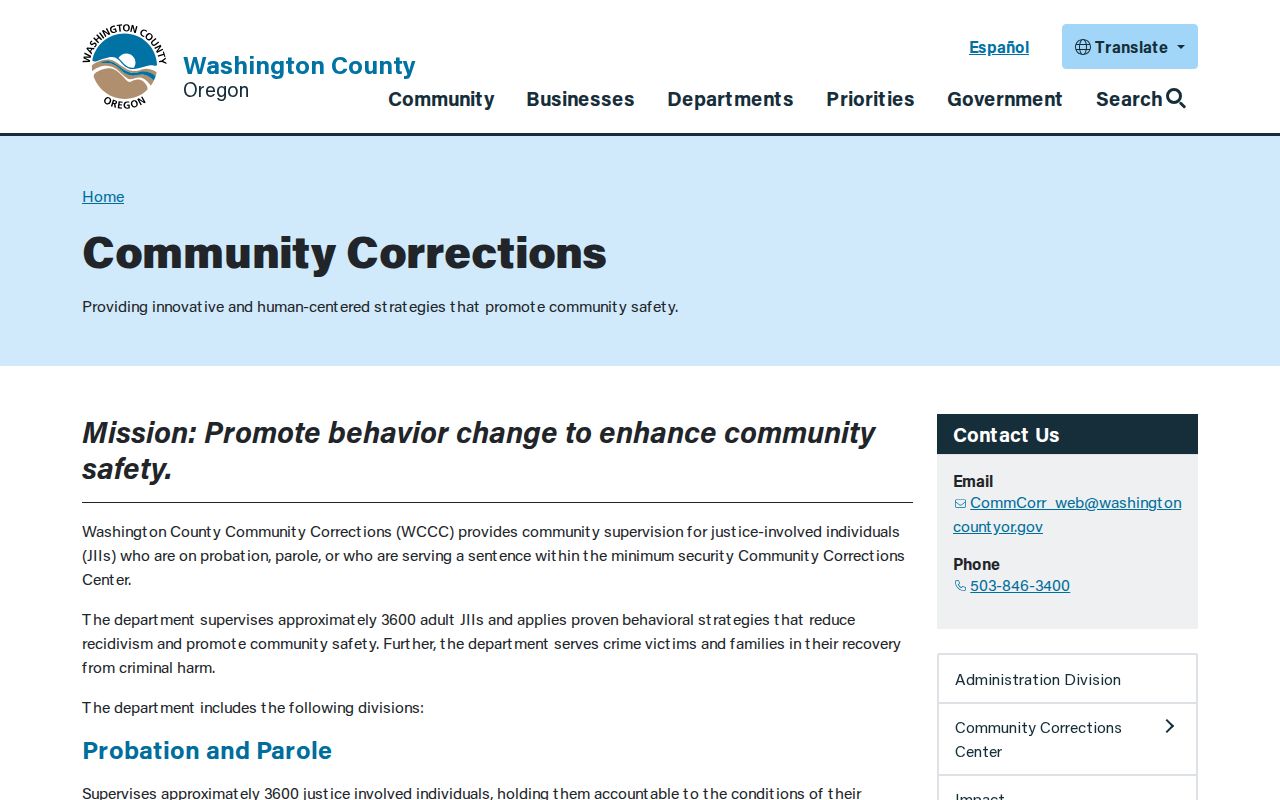
The county overview places WCCCC within Community Corrections rather than the sheriff's current-jail roster.
The jail and WCCCC sit near each other on SW Adams Street, but physical closeness does not merge their records. A jail release can lead to WCCCC, and a WCCCC resident can return to jail. Each move needs its own source. Calling either event a final discharge without checking the court and supervision record can erase an active legal status.
Community Corrections supervises about 3,600 adults across parole, probation, and post-prison supervision. That is not the WCCCC resident count. The center's 215 beds describe residential capacity, while the larger number describes broader field supervision. Keeping those measures apart prevents a false claim about who is physically housed at WCCCC.
WCCCC Property After Release
WCCCC keeps a former resident's belongings for 30 days after departure. The former resident may collect them with picture identification. After that period, unclaimed property may be donated or discarded. This local deadline is useful for post-departure planning, but it does not prove when the person left or where the person went.
If a former resident moved to Washington County Jail, the jailed person must sign the center's property-release form before another person can retrieve the belongings. The WCCCC FAQ source describes that process and the nonpublic transfer rule.
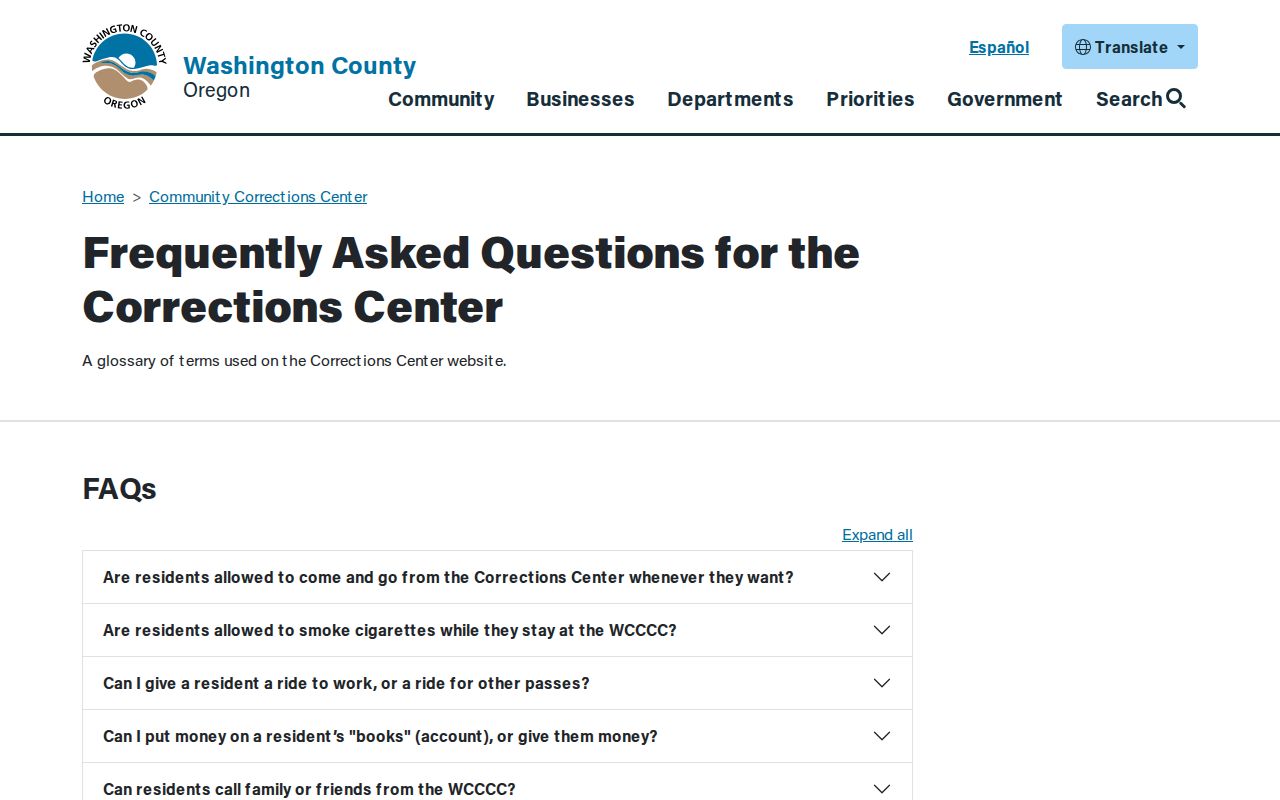
The FAQ shows why property pickup is a logistics clue, not an official release-date record.
Note: Contact the center before the property deadline, and use a separate Community Corrections or court record to verify departure.
WCCCC Release Versus Discharge
Leaving WCCCC is not necessarily discharge from the sentence or supervision. Probation is a court-ordered community sentence. Parole and post-prison supervision follow release from state prison under legal conditions. A resident may leave the center and remain accountable to a supervising officer, treatment plan, reporting schedule, or court order.
- Departure
- The physical end of a WCCCC residential stay.
- Transfer
- Movement into another custody or program setting.
- Supervision
- Community-based legal conditions monitored after or instead of physical custody.
- Discharge
- The later end of the sentence or supervision, when the official record says it ended.
Use the court case and Community Corrections record to keep those dates separate. A property pickup, missing jail result, or inability to obtain transfer timing cannot substitute for an official discharge. If supervision ends, request the document that states that outcome rather than inferring it from elapsed time.
Revocation can send a person back to jail or another structured setting. A new warrant or custody entry belongs with the agency that executed it, while the court and supervising office explain the violation. Do not treat the end of a WCCCC stay as proof that all conditions ended. A signed discharge or final court record controls that conclusion.
WCCCC and County ICE Releases
Washington County's published immigration-release policy is centered on the jail's release corridor. WCSO says time-served adults under ICE investigation are processed through the ordinary corridor rather than an in-jail sally-port handoff, automatic release emails ended in 2020, and an ICE jail hold requires judicially signed process. That policy does not turn WCCCC into an ICE release database.
If a WCCCC resident's record points to the jail, federal process, or immigration custody, trace each agency's transaction separately. The county policy is not proof of a named person's immigration status or later location. Use the court and Community Corrections records for WCCCC, the jail record for any county booking, and the appropriate federal source when the facts support that step.
Each source should retain its date, agency, and exact status wording. That record chain prevents a residential transition from being confused with final discharge or unrestricted community release.